Tied-up capital is the money sitting inside bought goods for as long as they remain unsold. You have paid for it, it stands on the floor instead of in the bank, and it earns nothing until somebody goes to the till. The longer the goods stand, the more expensive they get - even though the price tag never changes.
How to work it out
The simplest route runs through days in stock. Divide your average stock at cost by the annual cost of goods sold and multiply by 365. The result is how many days a euro is stuck in goods on average.
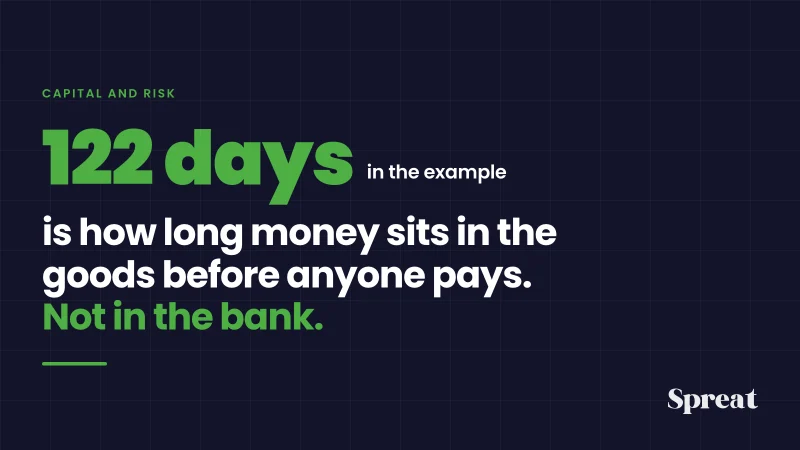
An example: €40,000 average stock, €120,000 cost of goods for the year. That is 40,000 ÷ 120,000 × 365 = roughly 122 days. Four months between paying and being paid. What it costs you depends on what the money would otherwise do: at 8% cost of capital, €40,000 comes to about €3,200 a year purely for standing there - markdowns, storage and insurance not yet counted.
- 122 days
- days in stock in the example
- €3,200
- cost of tied-up capital per year
- 3.0
- stock turn
€40,000 stock, €120,000 cost of goods for the year
at an assumed 8% rate on the stock
365 divided by the days in stock
Why it hits small stores harder
A chain treats tied-up capital as a metric. A small shop experiences it as a month. Put €4,000 into a new category and those €4,000 are no longer there for rent, staff or the invoice arriving next week - and whether the category works is something you learn in eight weeks at the earliest.
That is why assortments in small shops stay narrow when they ought to be wide. It is not a question of nerve, it is a question of liquidity. What a metre of space has to earn is set out in what a square metre of retail space has to earn.
The three levers
- Turn faster
Fewer variants per item, smaller order quantities, reorder more often. It acts immediately on days in stock, but costs more ordering effort and often worse terms.
- Pay later
Longer payment terms shift the tie-up to the supplier. It does not disappear, it just sits somewhere else - and in the negotiation you pay for it elsewhere.
- Do not buy at all
If the goods stay the brand's property until they sell, no capital is tied up. That is not better buying, it is a different relationship - and the reason an additional product then costs nothing up front.
What the third lever looks like in practice is set out in consignment stock in retail and in the comparison of the four models. The Viertelladen in Düsseldorf has lived it: ten producers became thirty-three, in the same space, with no buying budget.
Money that sits inside goods and is therefore unavailable for anything else. It starts the moment you pay an invoice and ends when the goods pass the till.
Average stock at cost divided by the annual cost of goods sold, times 365. The result is days. The inverse is stock turn - both numbers say the same thing from opposite ends.
At least the interest the money would otherwise earn, or that you pay on a loan. Add storage, insurance, shrinkage and - the most expensive item - markdowns on goods that no longer move at full price.
Three ways: turn faster, pay later, or carry goods that are not yours until they sell. Only the third lets the assortment grow while the tie-up falls.