
A square metre of retail space has to produce at least as much gross profit as it costs. The simplest way to work that out: take all space-related costs for a year - rent, service charges, energy, a share of staff - and divide by the sales area in square metres. The result is the floor every metre has to clear before anything is left over.
The maths, with an example
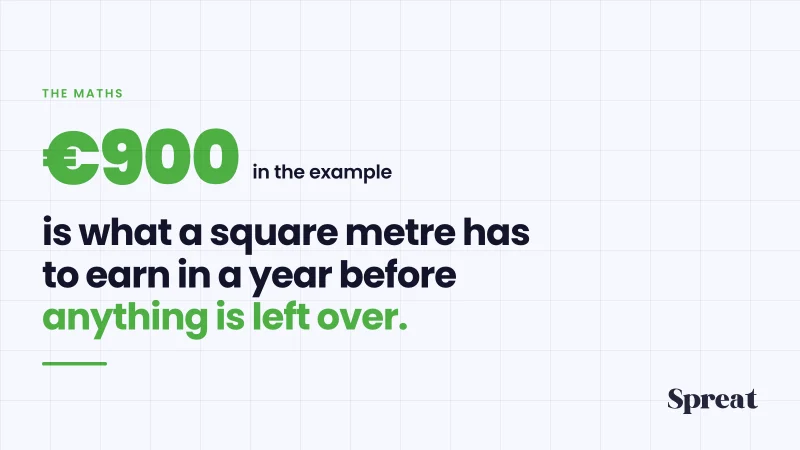
Say a store has 80 square metres of sales floor. Rent is €2,000 a month, service charges and energy €600, the share of staff attributable to the floor €3,400. That is €6,000 a month, so €72,000 a year. Divided by 80 square metres, that is €900 of cost per square metre per year.
Those €900 are gross profit, not turnover. At a 40% margin the same square metre therefore needs roughly €2,250 in sales a year just to carry itself. The figures are an example, not industry benchmarks - use your own, it takes ten minutes and afterwards it is a number you carry in your head.
- €900
- cost per square metre per year
- €2,250
- sales needed per square metre
- €6.16
- per square metre per day
in the example above, 80 m² and €6,000 of space costs a month
at a 40% margin, purely to cover
the same figure, divided differently - easier to hold in mind
Why the figure settles nothing on its own
The space calculation tells you what a metre has to bring in. It does not tell you what to put there - and that is where the real problem starts. A small store has two numbers pulling against each other.
One is space: with little of it you need choice, so every metre works. The other is liquidity: every euro tied up in goods is not in the bank - how to work out that tied-up capital has an article of its own. More choice means more capital tied up. Traditionally you do not resolve that contradiction, you pick a side.
A third way: let the metre work without buying it
The contradiction only dissolves once extra choice stops costing capital. If the goods belong to the brand until they sell, another product on the floor costs nothing up front - and the metre can try things instead of committing.
The Viertelladen in Düsseldorf-Unterbilk is the nearest example: ten producers became thirty-three, in the same space, with no buying budget. The space calculation did not change. What changed is how many attempts per metre are possible before the sums add up.
Turnover or gross profit divided by sales area, usually as an annual figure per square metre. It shows how hard the space is working. Comparisons across sectors say little - a jeweller and a furniture store are orders of magnitude apart.
For the coverage question, gross profit, because that is what remains after the cost of goods. Turnover per square metre is the better-known figure but says little without the margin.
For the floor, yes, because it costs rent. For the productivity figure, usually not - only sales area belongs in the denominator. What matters is deciding once and then staying with it, or you compare years that are not comparable.
There is none that holds across sectors. The useful comparison is your own: the same store, the same quarter last year, the same method. Anything else leads into the wrong argument.