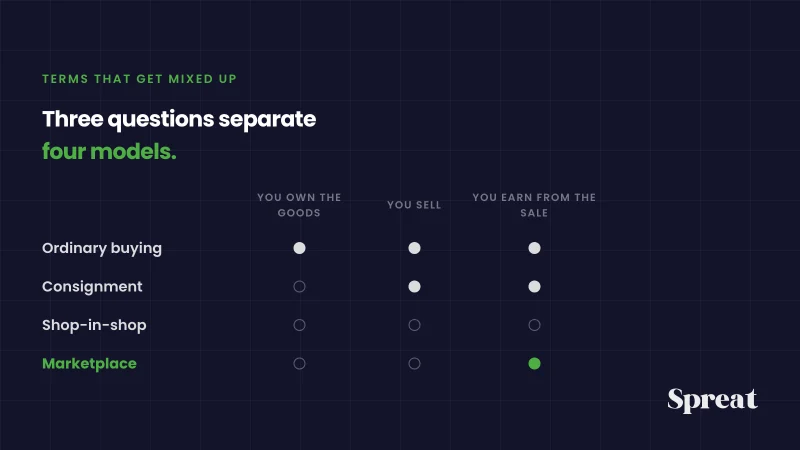
All four govern the same thing: how someone else's goods get into a store. They differ on two questions. Who owns the goods while they stand on the floor - and in whose name are they sold? Everything else follows from those two answers: who ties up capital, who carries the risk, and what gets settled.
- Ordinary buying: the store owns the goods, sells in its own name, pays up front
- Consignment and commission: the supplier owns the goods, the store sells in its own name, pays after the sale
- Shop-in-shop: the brand owns the goods, the brand sells, the store collects rent
- Physical marketplace: the brand owns the goods, the store brokers the sale, the store earns a commission
Consignment and commission
The goods sit with the retailer and belong to the supplier until they sell. Selling happens in the retailer's name but economically for the supplier's account - that is how § 383 of the German Commercial Code defines a commission arrangement.
The advantage is obvious: no buying, no tied-up capital, no markdown risk. The price is administration. Every supplier needs an agreement, separate stock records and a regular statement. With two suppliers that is a spreadsheet; with twenty it is a part-time job.
Shop-in-shop
A defined area inside a store where a brand has its own presence - its own fixtures, often its own staff, sometimes its own till. Classically the brand rents that area and pays whether or not anything sells.
For the store this is the safest variant: the rent arrives however the month goes. It is also the least flexible. A shop-in-shop only works from a certain size, it has a term, and for small brands it is too expensive. Anyone wanting to widen an assortment with five brands cannot do it this way.
Physical marketplace
The model moves the logic of an online marketplace onto retail space. The goods belong to the brand, the store provides the space and brokers the sale. The customer picks up the product, pays at the familiar till and gets her receipt - legally, in that moment, she buys directly from the brand.
The difference from commission sits exactly here: the store does not sell in its own name. For these goods no purchase and sale appear in its books, only a commission statement. And because that runs through the point of sale, the effort does not grow with every additional brand - which is the point at which two suppliers can become thirty-three.
How to choose
If you want to hand a large fixed area to a strong brand and need predictable income: shop-in-shop. If you have few suppliers you look after individually anyway and do not want to introduce software: commission. If you want to widen the assortment without the admin widening with it: the marketplace model.
And if you currently cannot tie up any capital but need choice, all three answer the same question - only the answer about administration comes out differently.
In everyday use, none. Consignment stresses where the goods are stored, commission the legal relationship under § 383 HGB. In retail both mean: the goods sit with the retailer and are not yet the retailer's.
No. Under commission the retailer sells in their own name for someone else's account. In the marketplace model they only broker - the purchase is made directly from the brand. For customers both look the same; for the store's bookkeeping they do not.
The brand pays rent to the store, regardless of turnover. In the marketplace model it is the other way round: payment comes out of the sale, not out of rent - no sale, no payment.
All three tie up no stock capital for the store, because it buys nothing. The difference is the running effort: shop-in-shop costs space and a term, commission costs administration per supplier, the marketplace model costs setting up the system.