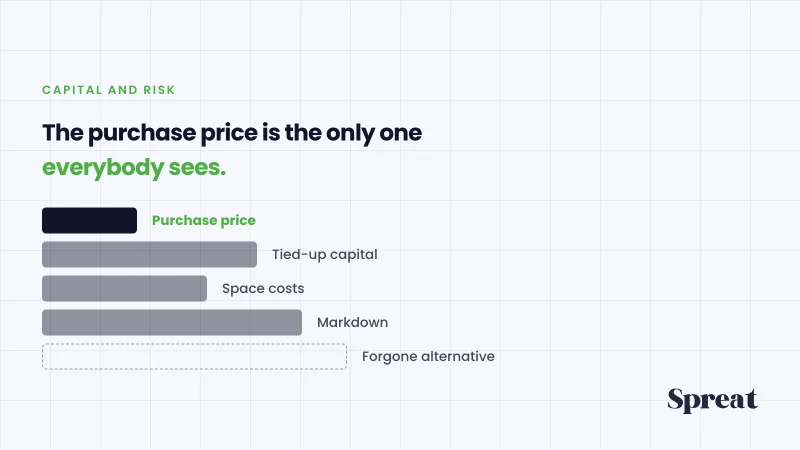
A bad buy costs more than what stood on the invoice. Added to the purchase price are the capital tied up for half a year, the floor the product occupied, the markdown when it finally sells - and the buy you could have made with the same money. The last item appears in no set of books and is often the largest.
The maths, with an example
You buy 60 units of an item at €20 net, planned selling price €49 net. Outlay: €1,200. After six months, 20 have gone. The remaining 40 go out at 50% off, so €24.50 instead of €49.
The exercise brings in 20 × €49 plus 40 × €24.50, together €1,960. That looks like a profit. But the gross profit is €1,960 minus €1,200, so €760 - for half a year of floor space and tied-up money. For comparison: the same spot with an item that turns brings several times that at three turns a year.
- €1,200
- cost of goods
- €760
- gross profit after the clearance
- 6 months
- of tied-up capital and occupied space
60 units at €20 net
instead of €1,740 at full price - a €980 markdown
the part that stands on no invoice
The five items
- Purchase price: the only one everybody sees
- Tied-up capital: the money sits in the goods until they sell - half a year in the example
- Space costs: every occupied metre costs rent, service charges and staff, whatever stands on it
- Markdown: the gap between the planned and the achieved price, here €980
- Forgone alternative: the item you could have carried with the same €1,200
How to work out the second item is set out in tied-up capital in retail; what the third amounts to per square metre, in what a square metre of retail space has to earn.
Why buying happens anyway
Because otherwise the assortment does not grow. Reorder only what already turns and in two years you have the same shelf as today - and customers notice that sooner than the owner does. Every shop needs attempts.
So the real question is not how to avoid bad buys but how much an attempt may cost. If it costs €1,200 and half a year, you make two a year. If it costs nothing but space, you make twenty - and out of twenty attempts comes an assortment you did not have to guess.
That is exactly where a marketplace model adds up: if the goods belong to the brand until they sell, purchase price, tied-up capital and markdown all fall away, and what remains are the space costs. In the pop-up in Rhede, 449 items from eight brands stood on the floor ten days after the first delivery.
Anything that does not turn at the calculated price in the planned time. That is more than the outright dud: goods that only move at a discount are a bad buy too - they missed their calculation.
It depends on the sector and on how tightly you calculate - a general figure leads into the wrong argument. The useful comparison is your own previous year, using the same method.
For the loss, at cost, because that is the money that has gone. The markdown, by contrast, is measured against the planned selling price - otherwise a discount looks smaller than what it cost you.
As many as you can afford without running short of liquidity for the core stock. Which is exactly why the question of what an attempt costs matters more than whether it succeeds.