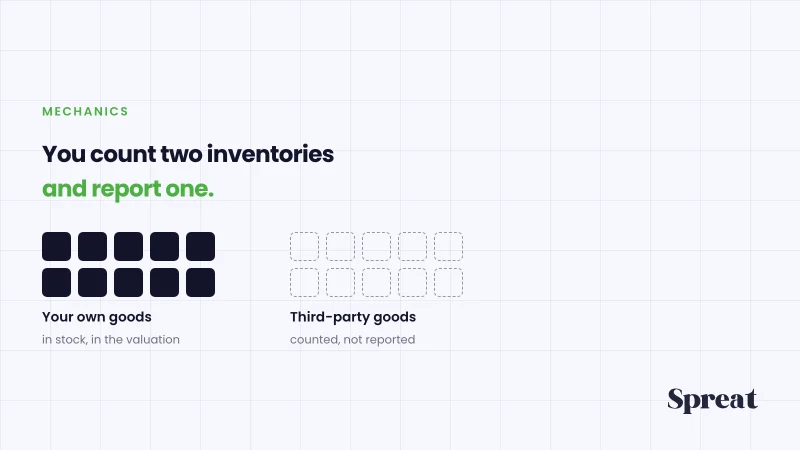
Goods that are not yours until they sell are not part of your assets. They stand on your floor, you are responsible for them, and they still do not appear in your stock. That does not make stocktaking harder, but different: you count two things and report only one.
What belongs in your own inventory
Only what you have bought and paid for. Third-party property does not belong in your stock valuation - neither consignment goods nor goods standing on your floor through a marketplace model.
You still need to know what is there. Not for the balance sheet but for the supplier and for yourself: discrepancies in third-party goods are a matter between you and the brand, and whoever does not count cannot settle them.
How to separate it in practice
- Record separately, do not store separately. The goods may stand side by side on the shelf; what has to be separate is the recording.
- Reportable per owner. Which item belongs to which brand has to come out of the system - otherwise every query turns into a search party.
- The date matters. Whatever is still third-party on the cut-off date and sells the day after does not belong in your stock. The transfer happens at the till.
- Shrinkage is either agreed or it is an argument. Who covers damage and theft on the floor belongs in the agreement, before the first delivery arrives.
Why your metrics look different afterwards
Stock turnover improves when third-party goods stand on the floor - not because you buy better, but because the denominator gets smaller. That is not creative accounting as long as you know it and say so.
Anyone wanting to steer both keeps two numbers: turnover for your own goods, sales per metre for the floor. One measures your capital, the other measures your shop. More on that in calculating stock turnover and what a square metre of retail space has to earn.
Count them yes, include them in your own inventory no. They are third-party property and do not belong in your stock valuation - but you have to know and be able to evidence what stands on your floor.
That is a matter of contract and belongs settled before the first delivery: damage, theft, loss. Without that rule, every discrepancy becomes a discussion.
It rises, because your own stock is smaller while the floor shows more. The figure then measures only your own assortment - which is fine as long as you know it.
What matters is who owns the goods on that day. The transfer happens at the till, not on delivery - see [how a purchase in a store legally lands with the brand](/stories/industry/buying-directly-from-the-brand).