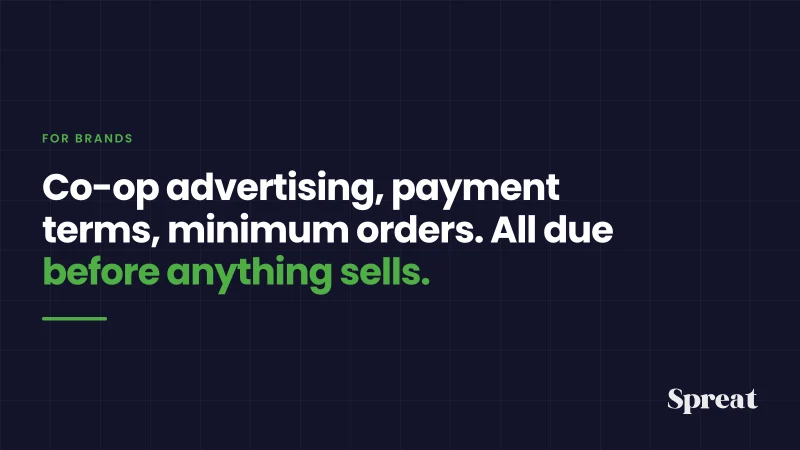
When a retailer buys your goods they take on a risk - and take securities in return. Those are called co-op advertising, payment terms, minimum orders and sometimes a listing fee. Each item on its own sounds like a negotiating detail. Together they are the amount you pay before a single unit has sold.
Co-op advertising contribution
A contribution from the brand towards advertising and placement: a leaflet page, a secondary display, a newsletter, sometimes simply a percentage of purchase volume. It is the most flexible item and therefore the one most talked about.
How solid the return is varies. A leaflet page can be checked; a flat percentage “for marketing effort” cannot. Ask specifically what you get for it, and have it written down.
Payment terms
The period after which the retailer settles your invoice - 30, 60, sometimes 90 days, often with a discount for paying earlier. For the retailer that is liquidity; for you it is pre-financing: you have produced and delivered, the money comes later.
For a small brand this is the underestimated item. Sixty days on a delivery that has already tied up capital is two months in which your money works for somebody else.
Minimum order
The quantity the retailer orders at minimum - or that you must deliver for the terms to apply. It makes logistics plannable and is exactly the item on which a cautious test fails: anyone wanting to try twenty units in three shops is often told it does not work below two hundred.
Listing fee
A payment for being taken into the range, regardless of whether anything sells. Common in grocery and with large chains, rare in small-format retail. Where it is asked for, it is the most honest item: it says openly that the space costs something.
What remains when nobody buys
If the store does not buy, the basis for all four items falls away - it carries no stock risk to insure itself against. What remains is a commission that only falls due once something sells.
That is not free either. What does apply instead is set out in what it costs to be in someone else's store; how the four routes differ overall, in the four routes a brand takes into retail.
A payment from the brand towards advertising and placement at the retailer - as a lump sum, as a percentage of purchase volume, or against a specific service such as a leaflet page. It is only solid with a named service attached.
It varies too much for a figure that holds - by sector, retailer size and what is given in return. If you need a benchmark, take it from two or three real offers rather than from a rule of thumb.
Yes, and it is expected. The room is greatest where you can offer something that removes risk from the retailer - a smaller first order, a right of return, a commitment to resupply.
Then it is the wrong door. For a first test you need a route that works without a minimum quantity - otherwise you finance the insight with goods that stay in the warehouse.