When a brand wants to get into a store, the route leads through a conversation in which someone is asked to take a risk. The retailer buys the goods, pays for them, puts them out - and if they sit there, it is his money tied up in the goods. That is why you hear “maybe next season” so often in these conversations. It is one of four routes into retail - and the one where the most is paid up front.
That is not a communication problem. It is math that does not add up for the retailer as long as he is the one paying.
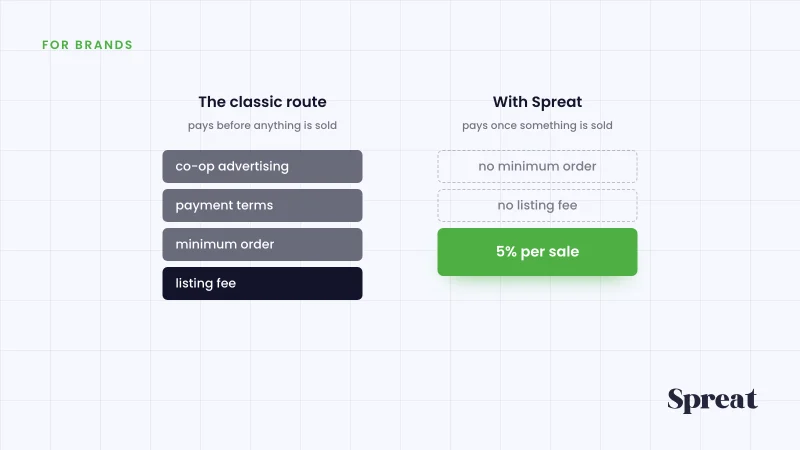
The classic route, itemized
- A sales meeting, often several, often spread over months
- Terms: purchase price, volume discounts, advertising cost subsidies
- A minimum order, so the effort pays off for the retailer
- Payment terms - until then the money sits with the retailer, not with you
- With some chains, a listing fee before a single unit has been sold
For a large brand this is a well-rehearsed process with a department of its own. For a small one it is the hurdle where it ends - not because the product is bad, but because nobody on either side wants to carry the risk.
Selling without having sold
With Spreat the store does not buy your goods. They sit in its space and remain your property until a customer takes them to its till - and legally, in that moment, she buys directly from you. The store earns a commission you agreed beforehand.
That removes the entire list above. No purchase price, no minimum order, no payment terms, no listing fee. What remains are two items - and both only once something is sold.
- your call
- store commission
- 5%
- to Spreat
- €0
- fixed costs
depends on sector and product, you set it per offer
of the gross price, per product sold
no setup, no monthly fee
On top of that, €0.25 net per checkout at the till - not per product. If someone buys three of your items together, it is charged once and spread across the three.
The 5% is not a finder's fee. It covers payment processing including receipts, settlement with the store including its commission, and a view of every movement of your goods - store by store, in real time.
What it does still cost you
Being honest means saying it is not free. Your goods sit in someone else's space, and that capital is tied up as long as they are there. You pay the logistics there. If the store ends the offer, it sends unsold goods back at its own cost - there is no minimum term. If you call goods back yourself, you pay for the collection.
That is the complete list. It is short enough to make a test worthwhile that the classic route would never have allowed: one piece of space, one store, one season - and after that you decide with numbers instead of guesses.
How a store finds you
Through the Brandpool. It holds over 150 brands with more than 15,000 products, and stores with a profile see your products, your prices and your terms before they approach you - without obligation, and without you having to convince anyone first.
That reverses the order of the classic route: you are not the one convincing someone to take a risk. He picks out what fits his space - and takes none.