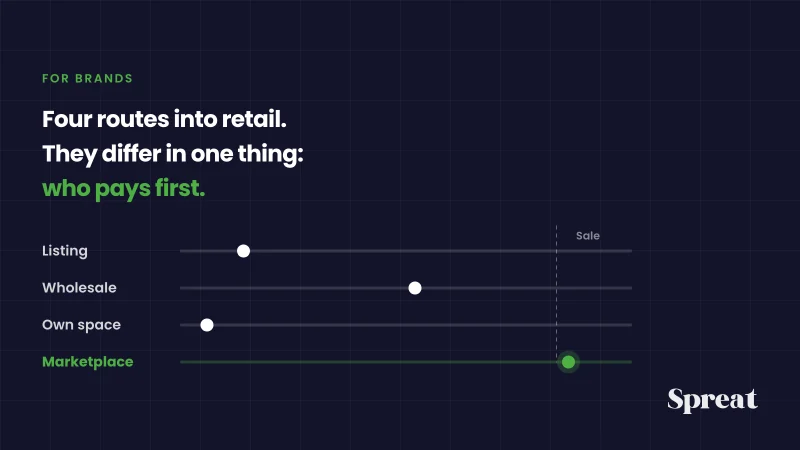
There are four routes into a shop, and the most important difference between them is not the effort but the moment of payment. With a classic listing the retailer pays up front and wants terms in return. With wholesale they pay later, but you lose a trade level. On your own space you pay for everything yourself. And in the marketplace model nobody pays before something sells.
Route 1: the classic listing
The retailer buys, pays and puts the goods out. Because that means taking on risk, they ask for something in return: purchase terms, often a co-op advertising contribution, payment terms, sometimes a right of return. What those items mean in detail is set out in co-op advertising, payment terms, minimum orders.
The upside: if it works you have volume and a partner with an interest in selling through. The downside is the road there - lead times of months, slots in buying rounds, and a conversation in which somebody else decides about your risk.
Route 2: through wholesale
You supply a wholesaler who distributes to many shops. That scales fastest and is logistically simplest - you have one customer instead of forty.
The price is double: one more trade level living off the margin, and the loss of proximity. You rarely learn which shop your product sits in, how it is presented, and why it does or does not move there.
Route 3: your own space
Your own shop, a shop-in-shop, a pop-up. Full control over presentation, price and customer contact - and full costs: rent, staff, fit-out, stock, all yours. For most small brands that is not a route into retail but a second company.
Route 4: the marketplace model
The goods stand in someone else's shop and remain your property until they sell. The store does not sell them on its own account, it brokers and earns a commission. There is no listing, no minimum order, no payment term - and no retailer paying up front.
It is not free: you carry the logistics there, your capital sits in goods standing in someone else's shop, and you pay a commission to the store plus 5% to Spreat. What that amounts to in detail is set out in what it costs to be in someone else's store.
How to choose
If you need volume and have lead time: listing. If you want breadth fast and can give up the margin: wholesale. If the brand can carry the space itself: your own store. If you want to know whether your product works in physical retail at all before making any of those three decisions: marketplace.
The four do not exclude each other. The usual path is to start with the cheapest test and then take the more expensive routes with numbers instead of guesses.
The one without a buying decision. Where a retailer does not have to buy, the conversation in which they weigh up their risk falls away - and with it most of the lead time.
Rarely only money. Typical items are purchase terms, a co-op advertising contribution, payment terms and a minimum order. Taken together, the brand pays before anything has sold.
As a rule yes, as soon as selling runs through a till. That is independent of the route and one of the things to settle before the first conversation.
Yes, and most brands do. What matters is that the prices fit together - a product that is cheaper in your own shop than in the store damages the store for you.