In the marketplace model the customer pays at the store's till but legally buys directly from the brand. The store does not sell the goods on its own account - it brokers the sale and earns a commission for it. The goods belong to the brand until the moment they pass the till.
What happens on the shop floor
- The goods arrive without being bought
The brand delivers to the store. There is no incoming invoice, because no purchase takes place. Ownership stays with the brand, and whatever has not sold can go back at any time - there is no minimum term.
- The purchase at the till
The customer takes the product and pays as always. The contract of sale is between her and the brand; the store handles the transaction. The receipt shows who sold it.
- The split in the same moment
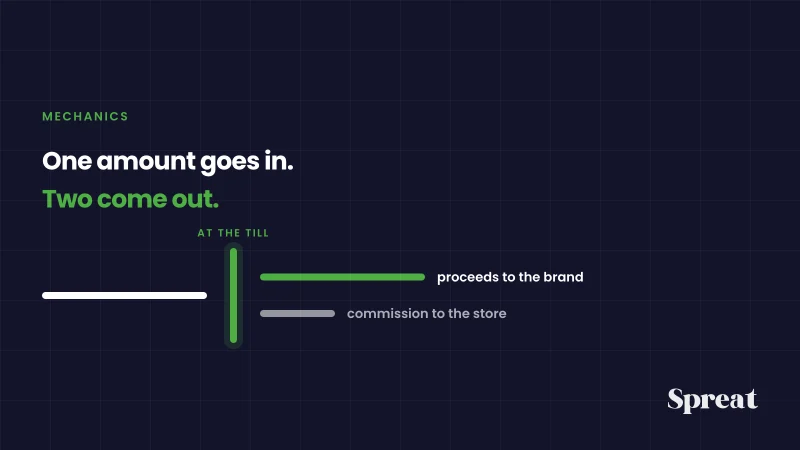
The point of sale separates the amount at the moment of sale: the proceeds belong to the brand, the agreed commission to the store. This is not a later reconciliation, it is part of the transaction.
- The payout
The store receives its commission, the brand its share. No purchase and no resale arise for the store - only a commission statement.
Why that makes a difference for the store
The obvious part is capital: what is not bought ties nothing up. The less obvious part is the bookkeeping. For goods the store never owned, no purchase and sale of its own arise - no incoming invoice, no payment terms, no supplier reconciliation per brand.
And the effort does not grow with the number of brands, because settlement hangs on the sale rather than on a list. That is the difference between two brands on the floor and thirty-three. How this differs from a classic commission arrangement is set out in consignment, commission, shop-in-shop, marketplace.
What applies to the brand
Because it is the customer's contractual partner, warranty and product responsibility stay with the brand - just as they would in its own online shop. In return it sees what sells where, and does not have to convince anyone to buy its product first.
What that means in costs is set out in what it costs to be in someone else's store.
The brand. The store handles the purchase at its till but does not act as a seller on its own account. That is the difference from a commission arrangement, where the retailer sells in their own name.
Who sold the item. For the customer the transaction looks like any other - a receipt, a payment, a product in the bag - but the document names the seller correctly.
In practice the store on site; responsibility stays with the brand. How that works in detail is agreed between the two before any goods are delivered.
After the sale, on a fixed rhythm. The split itself happens in the transaction; the payout follows the statement.
The brand, until they pass the till. That is why no stock and no tied-up capital arise for the store - see [tied-up capital in retail](/stories/industry/tied-up-capital-retail).