
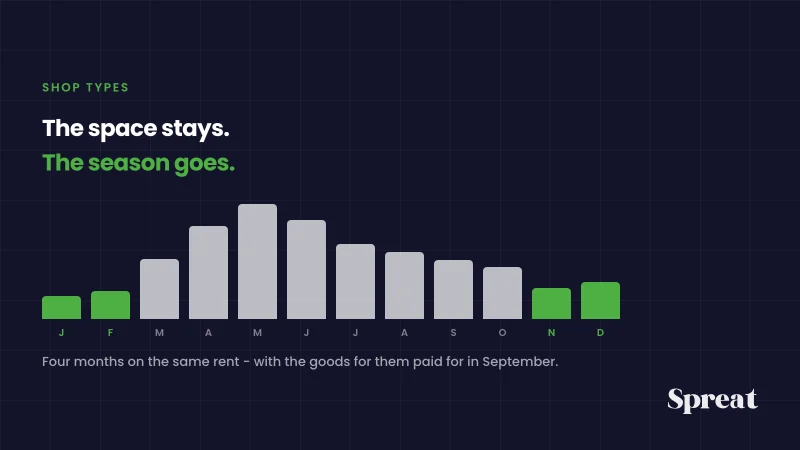
A garden centre has a problem no other retailer knows in quite this form: the space is as large in January as in May, so is the rent, and the turnover is not. Anyone wanting to fill the off-season has to buy for it in autumn - exactly when the money from the main season is already sitting in spring stock.
The off-season is a space problem, not a demand problem
People come in winter too, they just buy something else: decorations, gifts, candles, bird food, tools, ceramics. Those are categories a garden centre could carry and often does not - because they are a three-month bet paid for in September.
What a metre of that space has to earn does not change in the meantime. The maths is in what a square metre of retail space has to earn.
What changes when the seasonal goods are not yours
If the goods stay the brand's until they sell, the winter space costs nothing up front in September. What is left in February goes back instead of into the sale - and in a seasonal business the sale is the real loss, not the slow seller.
In practice: you can try three categories instead of one, because an attempt costs space and not capital. What a single misjudgement costs otherwise is in what a bad buy really costs.
Three limits we know about
- Plants are not the case. Living goods need care, have no shelf life in the usual sense and cannot simply be boxed up and sent back. This is about the dry range beside them.
- Outdoor space is harder than indoor. Goods belonging to the maker should not stand unprotected in the rain. If you do not want to settle responsibility for weather damage, start inside.
- The season sets the term. There is no minimum term: Christmas decorations stand from November to January and go back afterwards, and a three-week promotion works the same way. Whatever is left after the season goes back to the brand - you pay for the return, not for the leftovers.
No. Living goods need care and cannot sensibly be sent back. The model targets the dry range: decorations, gifts, ceramics, tools, accessories.
Anything people come for anyway and that keeps - Christmas decorations, candles, bird food, regional gifts, home accessories. Footfall is lower in winter, but it is not zero.
Possible, but weather damage has to be settled first. If you do not want that in a contract, start with the covered area - there the question does not arise.
Especially there. The more square metres stand idle over winter, the bigger the difference between an empty space and one that cost nothing.