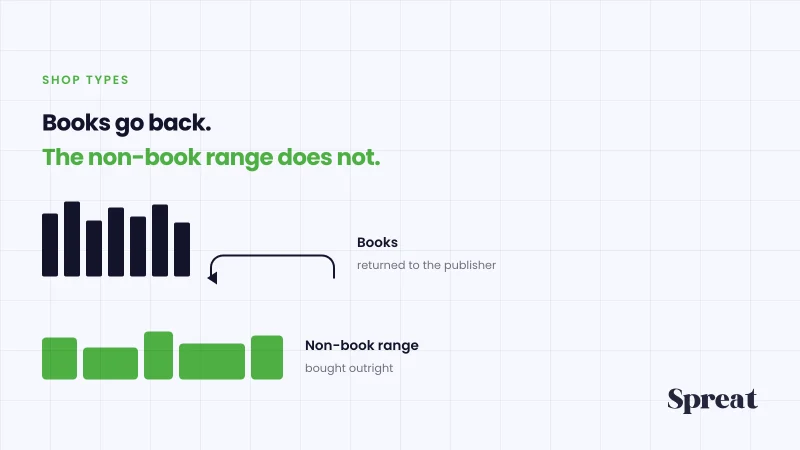
With books, a bookshop has always worked at low stock risk: what does not sell goes back to the publisher. That does not apply to the non-book range. Stationery, games, cards and gifts are bought outright - and that part has been growing for years as a source of margin. The risk has moved to exactly where the margin is needed.
Why the non-book range in particular
In Germany the retail price of a new book is fixed by law. That removes price as a lever and leaves two: quantity, and everything that is not a book. So the second lever is where the work happens - cards by the till, calendars in autumn, games before Christmas, a gift corner all year.
But that is the part nobody takes back. A box of calendars in January is not a return, it is a markdown. And because the non-book range is seasonal, the decision always falls months before the sale.
What changes when the goods are not the bookshop's
If the goods stay the brand's until they sell, the gift corner stops being a purchase and becomes a space. The bookshop earns a commission when something passes its till, and what does not move goes back - the same principle it knows from books, applied to the part where it was missing.
In practice: you can try in October whether a local ceramicist works for your customers, without having paid for it in July.
Three limits we know about
- Books themselves are not the case. The fixed retail price and the established routes through wholesalers and publishers are not a problem in need of solving. This is about everything beside them.
- You need a till that plays along. Settlement runs through the sale itself. Where there is still no stock system, that is the first step, not the second.
- Below a corner it is not worth it. Two sets of cards do not justify the effort. It gets interesting with a table, a metre of shelf, a seasonal display.
How that adds up is set out in what a square metre of retail space has to earn; why tied-up capital is the second number, in tied-up capital in retail.
No. Books have a fixed retail price in Germany and established supply routes with the option to return. The model targets the non-book range - stationery, games, gifts, local makers.
Nothing. Price fixing covers books, not calendars, cards or ceramics. It does not apply to the non-book range in the first place.
A table or a metre of shelf is enough to start. The effort per brand stays the same however little stands there - which is why it pays from a coherent corner, not from a single product.
Especially there. With little space and little spare liquidity you can hardly try anything otherwise - and with a non-book range, trying is the only way to learn it.