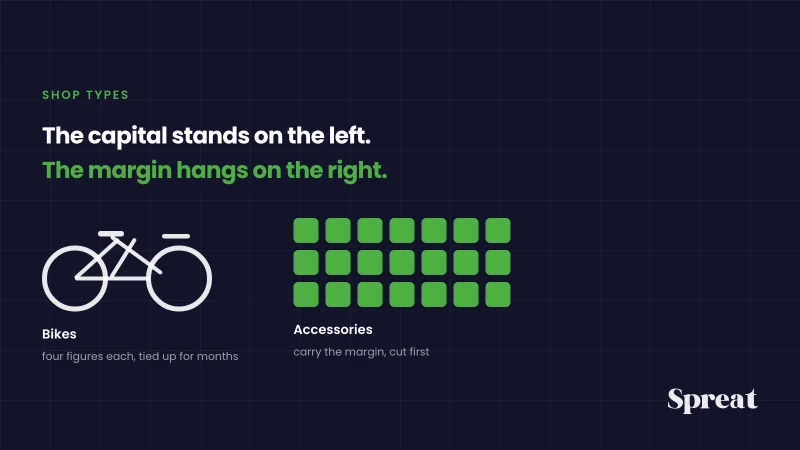
A bike shop has a capital problem on two floors. Below stand the bikes: each ties up a four-figure sum, often for months, and in winter half the shop stands still. Above sit the accessories - locks, helmets, apparel, care products, bags - which carry the margin and are still the first thing cut when liquidity gets tight.
Why the accessories are what suffers
Because they are the only line you can cut at short notice. The bikes are ordered, often seasons in advance; the workshop runs regardless. What is left is the accessory wall - and that is exactly where a repair does or does not turn into an additional sale.
Then there is the season. From October to February the space is there, the rent is there, and the turnover is not. Anyone wanting to try something new in that window pays for it out of the same account the spring order comes from.
What changes when the accessories are not yours
If the goods stay the brand's until they sell, an additional accessory brand costs nothing up front. You earn a commission when something passes the till - and what does not move in spring goes back, instead of going out at a discount a year later.
For winter that means something concrete: the dead season becomes the test season. A regional bag brand, a care range, apparel from a small label - three attempts then cost space and attention, not capital.
Three limits we know about
- The bike itself is not a good case. Advice, assembly, set-up and the responsibility after the sale hang together. A bike that is not yours makes that chain more complicated, not simpler.
- The workshop is the core business, not the floor. Where the shop is mostly workshop and the sales area is a corridor, there is little to gain. It needs a wall or a corner that genuinely sells.
- You need a till that plays along. Settlement runs through the sale itself. Anyone still working with a notepad and a handshake starts there.
What the capital tied up in bikes costs you is worked out in tied-up capital in retail; what a misjudged accessory buy really costs is in what a bad buy really costs.
It is not meant to. A bike needs assembly, set-up and clear responsibility after the sale. The model targets accessories, apparel, care products and bags.
The season is the reason it adds up. Accessories that do not move in winter cost you nothing if you never bought them - and in spring they are already there.
A wall or a corner. The effort per brand stays the same however little hangs there - which is why it pays from a coherent area, not from three items.
Not necessarily. It is about what you do not carry today because you do not want to pre-finance it - not about replacing what already works.