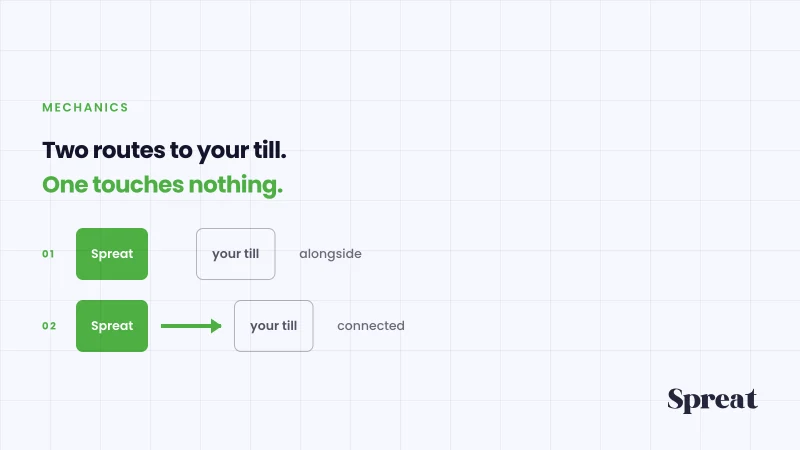
There are two ways for someone else's goods to be sold through a till. Either a standalone till runs alongside - without touching existing systems - or the platform connects by interface to what is already running. The first route needs a computer with a browser, internet and a card terminal. The second needs a till system with an interface, and somebody to connect it.
Route 1: standalone alongside
The Spreat till stands next to the existing setup and handles only sales of third-party goods. No interference with running systems, no coordination with the till vendor, no project.
The price is two transactions at the counter: anyone buying one of your own products together with a third-party one pays twice. For a shop with one corner that is a non-issue; for a branch with long queues it is not.
Route 2: through an interface into the existing till
Third-party products appear in the existing till system like your own: one receipt, one payment, one queue. Behind it the amount is separated at the moment of sale and assigned to the brand.
That requires your till system to offer an interface and somebody to build the connection. The effort sits once on the technical side and at zero afterwards. freenet widened its assortment this way - by its own account with no integration effort of its own.
What to settle beforehand
- Does your till system offer an interface? That decides whether route 2 is even on the table.
- How many transactions do you have at peak? Two tills are irrelevant at twenty customers a day and not at two hundred.
- Who looks after the till today? For a chain that is a different question from a shop with three people - and usually the one that sets the timetable.
- What does the receipt say? The document has to name the seller correctly. That holds on both routes and is not a matter for negotiation.
Why the receipt has to say that at all is set out in how a purchase in a store legally lands with the brand.
No. Either a standalone till runs alongside, or the platform connects by interface to your existing system. Neither route involves a change.
A computer with a browser, internet and a card terminal. Nothing more - which is why this route is the faster of the two.
It depends on the till system and who looks after it. There is no reliable figure, because the range runs from “the interface exists” to “the vendor has to agree first”.
Yes, and that is the usual path: start standalone, connect when volume demands it. Starting out of the box closes nothing off.