A farm shop has something town centers run expensive campaigns for: customers who come because of provenance. Anyone taking the detour down the farm track does not just want eggs - they want to know which farm they are from.
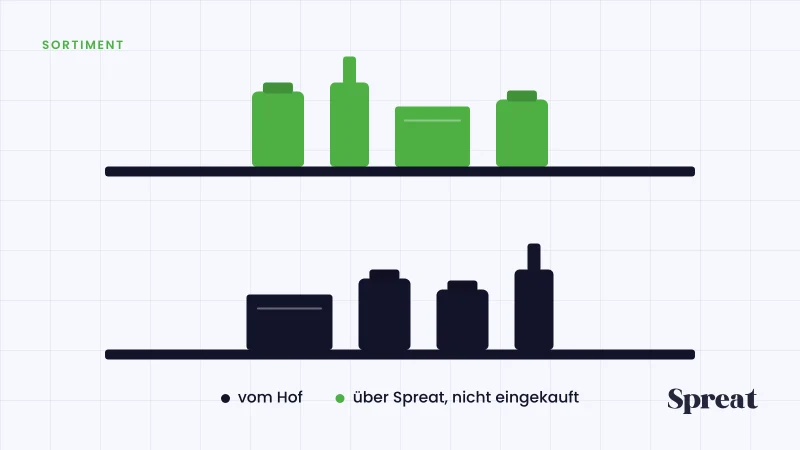
And it has a problem no marketing can solve: the assortment ends where the farm ends. In summer it piles up, in February the space looks thin. And when someone does make the drive, there is too little to offer them.
The classic route means buying
The standard solution is to bring in goods from others: honey from the beekeeper in the next village, regional pasta, soap, ceramics, jam. Except that means buying - with minimum quantities, tied-up money and the risk of being stuck with twelve jars of quince jelly in March.
For a business whose liquidity hangs on the harvest anyway, that is the wrong order. So it often stays at two or three products from people you know - and at a space that does less than it could.
Other people's goods, without buying them
With Spreat the producer puts their goods in your space, and they stay their property until someone takes them to your till. You buy nothing, you pay nothing up front, and you earn a commission - how high depends on the sector and the product, and you agree it between you.
Whatever does not sell goes back whenever you want - there is no minimum term. Whatever does sell you see the same day in the system, product by product. That is knowledge a farm shop otherwise only has as a gut feeling at the till.
How well this works on a small scale is shown by the pop-up store in Rhede: eight brands from the surrounding area, 449 items on the shop floor, 883 units sold across seventeen trading days. No buying, no capital, and goods still arriving in the final week.
Where it does not fit
- Fresh produce with a short best-before date is the hard part - the closer a product sits to the chiller, the less a model in which unsold goods go back to the brand carries it
- There has to be a till. A space with an honesty box at the edge of a field does not work: settlement between customer, producer and farm runs through the till
- Two or three jars of honey are not worth the effort. It gets interesting with a corner, a table, a winter display - not with a single product
Where it does fit
For anything shelf-stable that fits the story of the farm without coming from it: preserves, pasta, oils, honey, soaps, candles, ceramics, woodwork. For the months when your own assortment is thin. And for the moment when someone is looking for a little something to take along after the shopping.
In the Brandpool you can see who might work before you call anyone: over 150 brands with their products. Once your store profile is set up, you see each brand's actual commission.