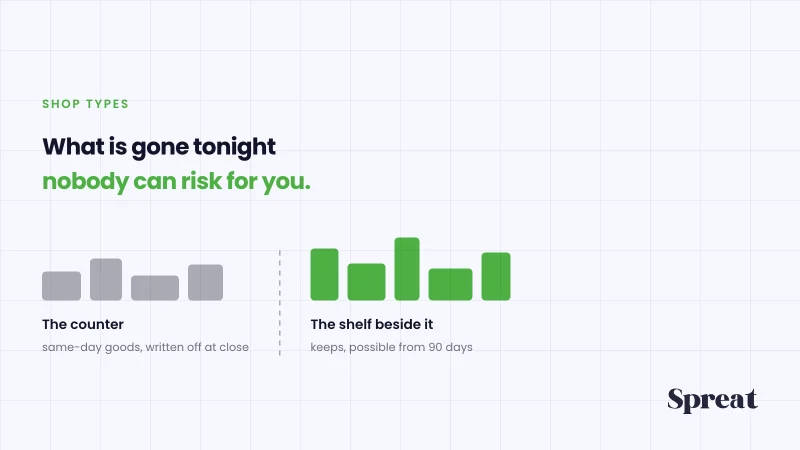
A bakery has two completely different assortments under one roof. At the front the counter: same-day goods, costed in hours, written off in the evening. Beside it the space holding what keeps - coffee, jam, ceramics, gift baskets. Nobody can carry the risk of the first zone for you. The second one, yes.
Why fresh is not the case
The marketplace model has no minimum term - the store can send unsold goods back at any time. The limit lies elsewhere: the goods belong to the maker until they sell, and have to stay saleable for as long as they sit on the shelf. A loaf of bread is a different article after eight hours.
That is not a restriction to be negotiated away - it is the limit of the model. Ignore it and you build trouble, not assortment.
What works beside it
A bakery's footfall is its largest unused asset. A café with fifty guests in a morning has more contacts than many specialist retailers manage in a week - and most of them are standing there waiting for a coffee.
What stands there has to keep and has to fit the occasion: coffee and equipment, regional jam and honey, ceramics, something to take to a host. Traditionally every one of those shelves means a buying decision up front - in a business whose liquidity hangs on same-day goods.
Three limits we know about
- Anything that does not keep for weeks is out. No bread, no cake, no chilled goods, nothing filled. That is not negotiable.
- You need a till that plays along. Settlement runs through the sale. In a bakery with a receipt-only till, that is the first step.
- The counter stays the bottleneck. With eight people queuing in the morning, a second transaction is a real problem. Either the existing till gets connected, or the space waits for the quiet hour.
What the till looks like in both variants is set out in POS integration; what an additional metre has to earn at all, in what a square metre of retail space has to earn.
No. The goods belong to the brand until they sell and have to stay saleable for as long as they sit on the shelf - for fresh, chilled and filled products that means hours or days. It is the clearest limit of the model.
Things that keep and fit the occasion: coffee and equipment, jam, honey, ceramics, small regional gifts. Anything somebody picks up while they are waiting anyway.
A shelf or a table is enough. The effort per brand stays the same however little stands there - which is why it pays from a coherent corner, not from two jars.
It can. Where the peak is tight, the till question comes before the assortment question - otherwise an extra sale costs more time than it brings in.