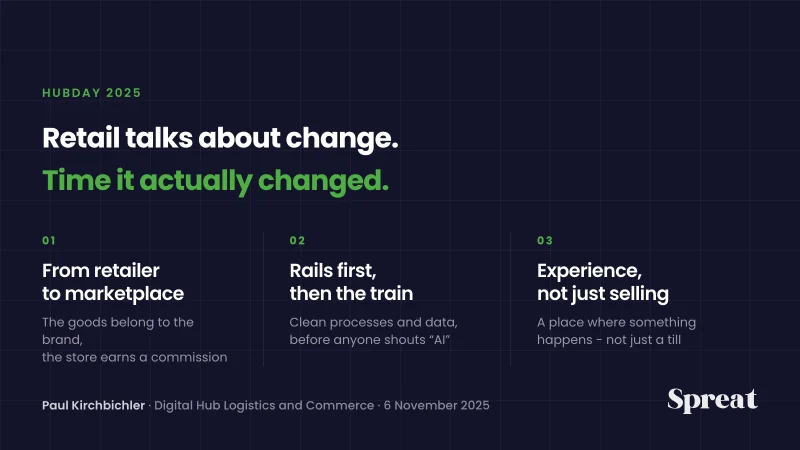
On 6 November 2025 the Digital Hub Logistics and Commerce hosted its HubDay. Paul's talk was called “Handeln statt Handeln” - a German pun on trading and taking action, and it carries the whole argument. Retail has been talking about change for years and acting on it far too rarely.
He opened with a request to the room: forget everything you think you know about retail. Not optimise it - pour the foundation again. What followed were three steps, in that order, and the order is the actual point.
- From retailer to marketplace
Retail has worked the same way since the Phoenicians: the shop buys, the shop sells, the shop carries the risk. Online that stopped being true long ago - buy on a marketplace and you usually buy from a brand, with the platform providing the stage. That is exactly what can be moved onto retail space.
- Rails first, then the train
Before anyone shouts “AI”: the fastest train in the world goes nowhere without rails. The rails are clean processes, clean data, simple systems. Simple systems beat complex ones - almost always.
- Experience, not just selling
People walk into a shop to touch something, to meet someone, or to have it right now. Once your processes are under control you have time for exactly that again. The store stops being a space with a till next to it and becomes a place where something happens.
What changes when the store does not own the goods
The customer stands in the shop, picks up a product, pays at the till - all as usual. Legally, in that moment, she buys directly from the brand. The store no longer earns a margin between buying and selling but a commission. What falls away is what ties down small retail most: the stock risk and the capital sitting inside it. And with the buying, the bookkeeping goes too - the talk put it at 95 per cent less accounting work for these goods.
The talk then moved on to what could follow from that. If the goods belong to the brand, it does not matter which store takes a return - either way the purchase was from the same brand. And the nearest store holding an item can become the logistics point for a same-day delivery. Sales channel and fulfilment channel would then be cleanly separated.
“Doing is like wanting - only better.”
The ending was personal. Paul founded his first company at sixteen, which German law does not really provide for - and spent half a year arguing about it before the Hamburg family court. The point he drew from it: do not wait for permission, and do not wait for the perfect moment. A child learning to walk falls over, and nobody forbids it.